Nick H: The Order of the Blind Witness
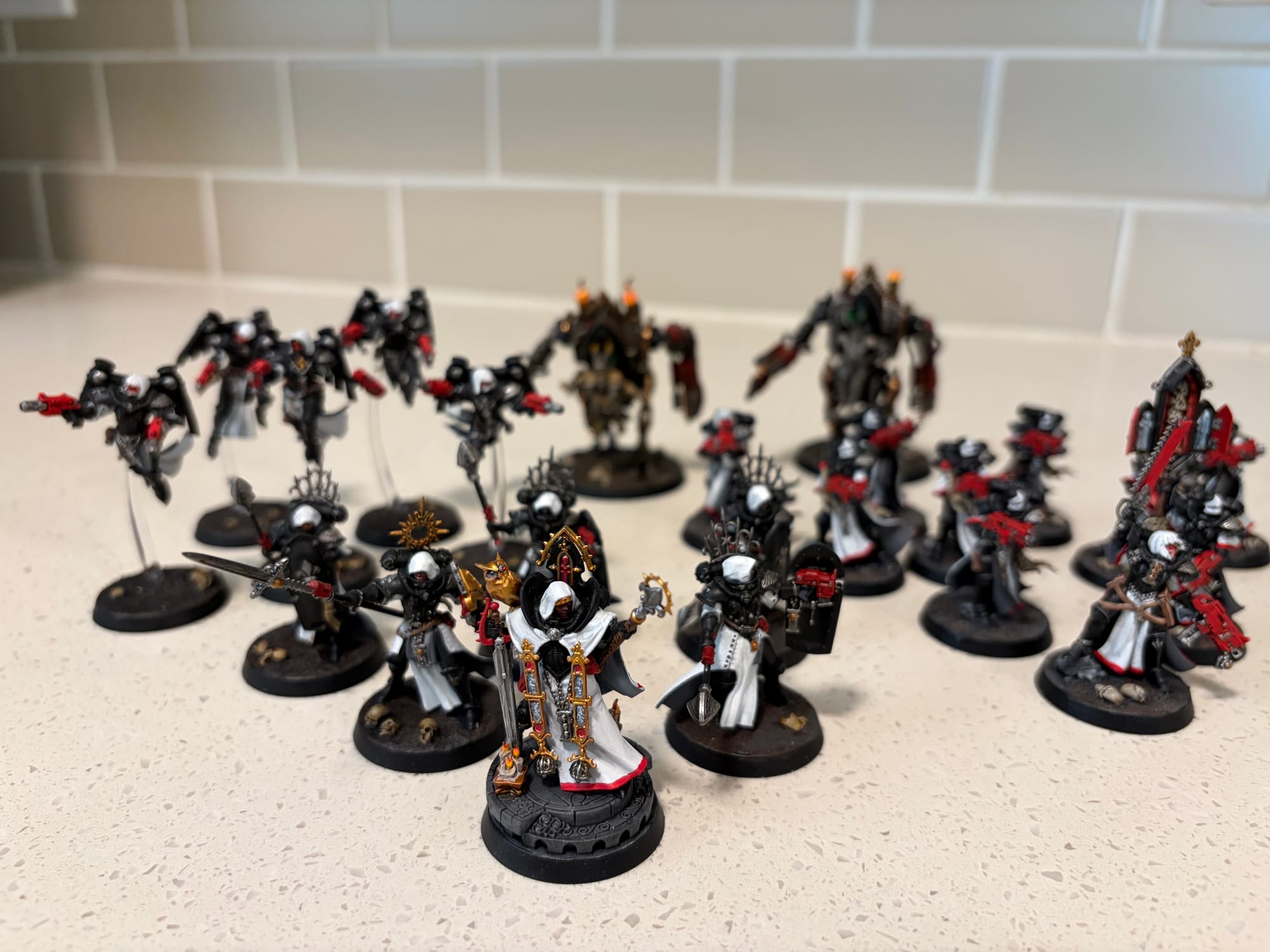
They do not seek glory. They do not seek recognition. They do not even seek to be remembered.
They only witness—and act.
Origin
The Order of the Blind Witness traces its origins to a minor shrine world on the fringes of the Segmentum Obscurus, a place once devoted to quiet pilgrimage rather than grand crusade. The world itself—now known as Sanctum Caecitas—was not strategically important, nor wealthy, nor especially devout by Imperial standards. It endured, unnoticed.
Until it didn’t.
When heresy took root there, it did not arrive with banners or warbands. It spread quietly—through whispers, through small compromises, through citizens who simply “looked the other way.” By the time the Ecclesiarchy responded, the world had already fallen into a soft, creeping apostasy.
But one among them could not look away.
She was a young woman, blind since birth, a minor attendant in one of the world’s lesser sanctums. She had never witnessed the Emperor’s light with her eyes, yet she claimed to feel when something was wrong—when prayers rang hollow, when sacred ground no longer felt sacred.
At first, she was dismissed. Then avoided. Then feared.
Because she was right.
As the taint of Chaos deepened, she began to speak with certainty. Not in grand sermons, but in simple, unshakable truths: something is here… something is wrong… we must act.
And some listened.
She gathered a small number of the faithful—laborers, pilgrims, even a few reluctant clergy—and led them in acts of quiet resistance. They were not soldiers. They were not trained. But they acted when others would not.
When the world finally descended into open ruin, her small band did not try to save it.
They could not.
Instead, guided by her strange and unwavering perception, they made for a relic vault long thought insignificant—one that the corruption had not yet reached. There, they recovered a sacred artifact of the Ecclesiarchy, a relic whose importance would only be understood later.
They did not escape.
The last accounts speak of the young woman placing the artifact into the hands of the arriving Sisters of Battle, moments before she and her followers were overrun.
She never saw what she had saved.
But she knew.
The First Witness
The Sisters who would become the Order of the Blind Witness arrived too late to save the world—but not too late to witness its failure.
Their Canoness, Verity Halbrecht, is said to have walked the ruined streets for three days without speaking, observing the aftermath of betrayal. Entire communities had not resisted. Not out of malice—but out of convenience, fear, or indifference.
On the fourth day, she ordered her Sisters to paint their faces in red from the eyes upward.
Not as a mark of rage—but of accusation.
“To see, and do nothing, is to be complicit. We will never again be mistaken for those who looked away.”
She named the Order not for herself, nor for the fallen world—but for the unnamed girl.
A woman who could not see, yet understood the truth more clearly than an entire planet.
A woman who proved that blindness is no excuse.
The Chalice of Dominica’s Veil
The artifact recovered from Sanctum Caecitas is known as the Chalice of Dominica’s Veil, named in reverence to Alicia Dominica, founder of the Orders Militant and first of the Emperor’s Brides.
Unlike many relics of the Ecclesiarchy, the Chalice is unadorned—aged metal, darkened with time, bearing only the faintest etchings of scripture along its rim. No jewels. No gilding. No outward sign of importance.
It does not draw the eye.
It does not need to.
Within the Order, the “Veil” is not blindness of the eyes, but the veil between truth and perception—the lie that not seeing absolves responsibility.
The Chalice represents the moment that veil is lifted.
And the responsibility that follows.
It is carried only in the gravest of circumstances, when corruption is believed to have taken root unseen. Its presence is not announced. It is simply… brought.
Those who stand near it often describe a quiet clarity. Not fear, not pain—just the absence of doubt.
For the Sisters, this is a gift.
For others, it rarely is.
Beliefs
The Order of the Blind Witness holds a stark and uncomfortable doctrine:
- Heresy thrives not only through the wicked, but through the passive
- Observation carries responsibility
- Faith without action is indistinguishable from cowardice
They are called “Blind” not because they cannot see—but because they reject the lie of ignorance.
To them, claiming blindness is the gravest sin of all.
Appearance and Symbolism
Their iconography is deliberate and severe:
- Red-painted faces (eyes to crown): a mark that they have seen
- Black armor: duty, endurance, and the burden of judgment
- White robes with red hems: purity stained by responsibility
They are not ostentatious. No gilded excess. No unnecessary ornamentation.
Everything they wear has purpose.
Combat Doctrine
The Blind Witness do not wage war with spectacle—they wage it with certainty.
Seraphim serve as the Order’s eyes made manifest, descending swiftly to identify and eliminate threats before they can spread. Sacresants form the unyielding core, guarding not just leaders, but the Order’s doctrine itself. Penitent Engines are a grim reflection of their beliefs—those who failed to act, now forced into action without end.
Their strategies favor:
- Rapid response over prolonged siege
- Precision over overwhelming force
- Relentless follow-through
If they arrive, something has already gone wrong.
Their purpose is to ensure it does not continue.
Reputation
Among other Imperial forces, the Order of the Blind Witness is respected—but rarely loved.
They are dependable. Tireless. Uncompromising.
They do not celebrate victories. They do not mourn loudly. They do not linger.
And perhaps most unsettling of all—they do not excuse failure, even when it is not their own.
Commanders who hesitate around them often feel… observed.
Current Deployment
The Order now operates across unstable frontier systems where Imperial control is thin and corruption spreads easily. They are sent not where war is loud—but where it is quiet, subtle, and dangerous.
Where something is off.
Where people have started to look away.